Interview Question1

Spring Bean.
What is Spring Bean?
A Spring Bean is an object managed by the Spring IoC (Inversion of Control) container. In the Spring Framework, beans are the backbone of your application, and they are created, configured, and assembled by the container. It is defined in a configuration file (XML, Java-based annotations, or Java Config) or discovered through component scanning.
A bean's lifecycle involves creation, initialization, use, and destruction, all managed by the Spring container.
There are 2 ways to create Beans - @Component and @Bean.
The IoC container instantiates the bean from the bean’s definition in the XML file. Spring then populates all of the properties using the dependency injection as specified in the bean definition.
When the bean implements the BeanNameAware interface, the container calls setBeanName(String beanId) method to pass the bean ID. If the bean implements BeanFactoryAware, the container calls setBeanFactory() to pass an instance of itself. If there are any BeanPostProcessors associated with the bean, the container invokes their postProcessBeforeInitialization() methods before calling any initialization callbacks (like @PostConstruct, afterPropertiesSet(), or a custom init-method). After initialization, if there are any BeanPostProcessors, their postProcessAfterInitialization() methods are invoked.
flowchart TD
    A["Bean Definition Loaded - XML / Annotation / Java Config"]
    B["Bean Instantiation - Constructor"]
    C["Dependency Injection - Populate Properties"]
    D["setBeanName() - if BeanNameAware"]
    E["setBeanFactory() - if BeanFactoryAware"]
    F["postProcessBeforeInitialization() - BeanPostProcessor"]
    G["Initialization Callbacks - @PostConstruct / afterPropertiesSet() / init-method"]
    H["postProcessAfterInitialization() - BeanPostProcessor"]
    I[Bean Ready for Use]
    J["Destruction Triggered - Context Shutdown"]
    K["Destroy Callbacks - @PreDestroy / destroy() / destroy-method"]

    A --> B --> C --> D --> E --> F --> G --> H --> I --> J --> K
Bean Lifecycle Code Example -
import org.springframework.beans.*;
import org.springframework.beans.factory.*;
import org.springframework.context.annotation.*;
import javax.annotation.*;

// Step 1: Create a Bean implementing lifecycle interfaces
@Component
public class MyBean implements BeanNameAware, BeanFactoryAware, InitializingBean, DisposableBean {

    private String beanName;

    public MyBean() {
        System.out.println("1. Constructor: Bean is instantiated");
    }

    // Called after properties are set via DI
    @Autowired
    public void setDependency(SomeDependency dep) {
        System.out.println("2. Setter Injection: Dependencies are injected");
    }

    // BeanNameAware interface method
    @Override
    public void setBeanName(String name) {
        this.beanName = name;
        System.out.println("3. setBeanName(): Bean name is '" + name + "'");
    }

    // BeanFactoryAware interface method
    @Override
    public void setBeanFactory(BeanFactory factory) throws BeansException {
        System.out.println("4. setBeanFactory(): BeanFactory is set");
    }

    // Called by BeanPostProcessor BEFORE initialization
    // (Handled by CustomBeanPostProcessor below)

    // @PostConstruct annotation method
    @PostConstruct
    public void postConstruct() {
        System.out.println("6. @PostConstruct: Post-construct method called");
    }

    // InitializingBean interface method
    @Override
    public void afterPropertiesSet() {
        System.out.println("7. afterPropertiesSet(): InitializingBean method called");
    }

    // Custom init method (if specified in @Bean)
    public void customInit() {
        System.out.println("8. customInit(): Custom init-method called");
    }

    // Called by BeanPostProcessor AFTER initialization
    // (Handled by CustomBeanPostProcessor below)

    // @PreDestroy annotation method
    @PreDestroy
    public void preDestroy() {
        System.out.println("10. @PreDestroy: Pre-destroy method called");
    }

    // DisposableBean interface method
    @Override
    public void destroy() {
        System.out.println("11. destroy(): DisposableBean method called");
    }

    // Custom destroy method (if specified in @Bean)
    public void customDestroy() {
        System.out.println("12. customDestroy(): Custom destroy-method called");
    }
}

// Step 2: BeanPostProcessor for pre/post initialization hooks
@Component
public class CustomBeanPostProcessor implements BeanPostProcessor {

    @Override
    public Object postProcessBeforeInitialization(Object bean, String beanName) {
        if (bean instanceof MyBean) {
            System.out.println("5. postProcessBeforeInitialization(): Before init");
        }
        return bean;
    }

    @Override
    public Object postProcessAfterInitialization(Object bean, String beanName) {
        if (bean instanceof MyBean) {
            System.out.println("9. postProcessAfterInitialization(): After init");
        }
        return bean;
    }
}

// Step 3: Configuration class
@Configuration
@ComponentScan
public class AppConfig {

    @Bean(initMethod = "customInit", destroyMethod = "customDestroy")
    public MyBean myBean() {
        return new MyBean();
    }
}
Output (in order):
1. Constructor: Bean is instantiated
2. Setter Injection: Dependencies are injected
3. setBeanName(): Bean name is 'myBean'
4. setBeanFactory(): BeanFactory is set
5. postProcessBeforeInitialization(): Before init
6. @PostConstruct: Post-construct method called
7. afterPropertiesSet(): InitializingBean method called
8. customInit(): Custom init-method called
9. postProcessAfterInitialization(): After init
--- Application Running ---
10. @PreDestroy: Pre-destroy method called
11. destroy(): DisposableBean method called
12. customDestroy(): Custom destroy-method called
Lifecycle Order Summary -
| Method | Interface / Annotation |
|---|---|
| Constructor | - |
| Setter / Field Injection | @Autowired |
| setBeanName() | BeanNameAware |
| setBeanFactory() | BeanFactoryAware |
| postProcessBeforeInitialization() | BeanPostProcessor |
| @PostConstruct | javax.annotation |
| afterPropertiesSet() | InitializingBean |
| init-method | @Bean(initMethod) |
| postProcessAfterInitialization() | BeanPostProcessor |
| @PreDestroy | javax.annotation |
| destroy() | DisposableBean |
| destroy-method | @Bean(destroyMethod) |
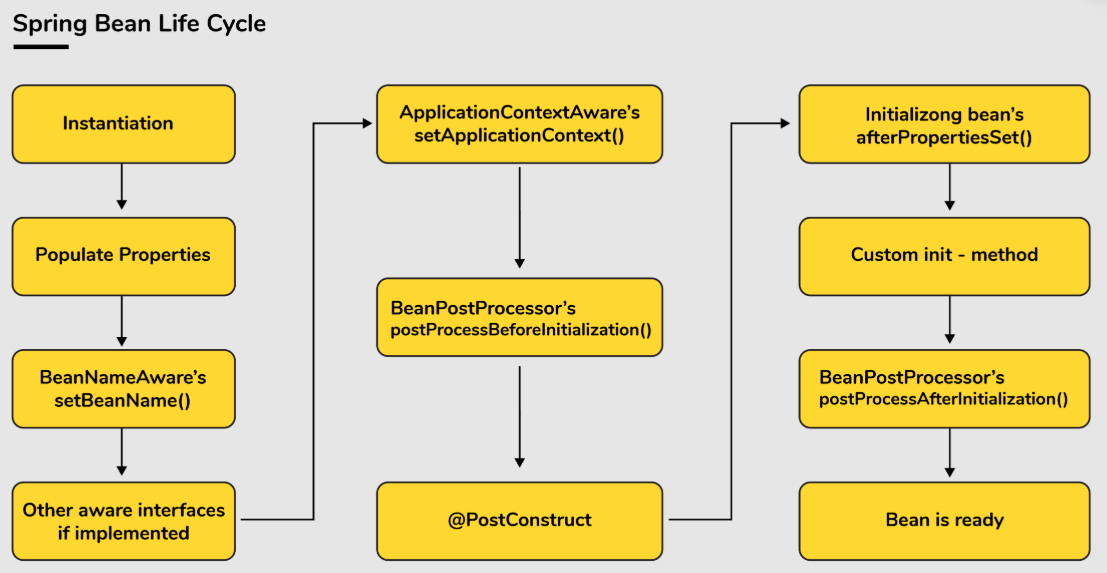
What is Bean Scope?
There are different bean scope that determines how and when they are created.
|Bean Scope|Description|
|----------|-----------|
|Singleton.|There will be a single instance of the bean is created for the entire Spring container.
Default scope. Only one instance created per IOC. Singleton are eagerly initialized by IOC ( means at the time of application startup, object gets created ).
Prototype - A new instance is created every time the bean is created. It is lazily initialized.
Request - A new instance is created for each HTTP request (web applications).
Session - A new instance is created for each HTTP session (web applications). When user access any endpoint the session is created. Remains active till it does not expires.
Global Session - Scoped to a global HTTP session (portlet applications).
Beans are cerated vis XML configuration files. Configuration like @Configuration and @Bean. Annotation-based configuration like @Component, @Service, @Repository, and @Controller.
Spring beans support dependency injection, where their dependencies are injected by the container rather than instantiated directly. This promotes loose coupling and enhances testability.
// Every injection returns the same instance.
@Component
@Scope("singleton")
public class SingletonBean {
    public SingletonBean() {
        System.out.println("SingletonBean instance created");
    }
}
// Each injection or context.getBean() call creates a fresh object.
@Component
@Scope("prototype")
public class PrototypeBean {
    public PrototypeBean() {
        System.out.println("PrototypeBean instance created");
    }
}
// Different instance for each incoming HTTP request.
@Component
@Scope(value = WebApplicationContext.SCOPE_REQUEST, proxyMode = ScopedProxyMode.TARGET_CLASS)
public class RequestBean {
    public RequestBean() {
        System.out.println("RequestBean instance created per request");
    }
}
// Same bean reused across requests in the same session
@Component
@Scope(value = WebApplicationContext.SCOPE_SESSION, proxyMode = ScopedProxyMode.TARGET_CLASS)
public class SessionBean {
    public SessionBean() {
        System.out.println("SessionBean instance created per session");
    }
}
// Rarely used — specific to portlet-based apps.
@Component
@Scope(value = WebApplicationContext.SCOPE_GLOBAL_SESSION, proxyMode = ScopedProxyMode.TARGET_CLASS)
public class GlobalSessionBean {
    public GlobalSessionBean() {
        System.out.println("GlobalSessionBean instance created per global session");
    }
}

public class ScopeDemo {
    public static void main(String[] args) {
        AnnotationConfigApplicationContext context = new AnnotationConfigApplicationContext(AppConfig.class);

        System.out.println("Testing Singleton Scope:");
        MyBean singleton1 = context.getBean("singletonBean", MyBean.class);
        MyBean singleton2 = context.getBean("singletonBean", MyBean.class);
        System.out.println("Are singleton beans same? " + (singleton1 == singleton2));

        System.out.println("\nTesting Prototype Scope:");
        MyBean prototype1 = context.getBean("prototypeBean", MyBean.class);
        MyBean prototype2 = context.getBean("prototypeBean", MyBean.class);
        System.out.println("Are prototype beans same? " + (prototype1 == prototype2));

        context.close();
    }
}
/*
The output.

SingletonBean instance created
PrototypeBean instance created

Testing Singleton Scope:
Are singleton beans same? true

Testing Prototype Scope:
PrototypeBean instance created
PrototypeBean instance created
Are prototype beans same? false
*/
<br
Inner Bean - An inner bean in Spring is a bean defined inside another bean’s configuration, typically in XML, and it exists only within the scope of its enclosing bean. It’s used when a dependency is tightly coupled and not meant to be shared across the container.
An inner bean is a bean declared within the
It is used when the dependency is private to a single bean and should not be reused elsewhere. Inner beans are anonymous — they don’t have an id or name and cannot be injected into other beans.
<bean id="outerBean" class="com.example.OuterBean">
    <property name="dependency">
        <bean class="com.example.InnerDependency">
            <property name="value" value="Injected via inner bean"/>
        </bean>
    </property>
</bean>
<!-- InnerDependency is an inner bean. It is created with outerBean and has no global bean id. -->
Bean Initialization -
| Type | When Created | Scopes | Why |
|---|---|---|---|
| Eager | At application startup | Singleton (default) | Fail-fast — wiring errors surface at boot, not later |
| Lazy | On first actual use | Prototype, Request, Session | Saves memory/time for beans that may never be used |
Why Eager?
Singleton beans are created eagerly because Spring wants to validate the entire application context at startup.
If a dependency is missing, a circular reference exists, or a config is wrong — you find out immediately when the app boots, not when a user hits an endpoint at 2 AM in production.
This is the fail-fast principle — catch problems early, not late.
Eager (Singleton) — Spring pre-creates all singleton beans at startup. Fails fast if wiring is broken.
Lazy (Prototype etc.) — Bean is created only when getBean() is called or it is injected. A new instance every time.
You can force any bean to be lazy using @Lazy on a singleton.
@Component
@Lazy // Created only when first injected, not at startup
public class HeavyReportService { }
Use
@Lazysparingly — it trades startup safety for deferred load time.
What is Bean Factory?
A BeanFactory in Spring is the root interface for accessing the Spring IoC container. It defines the fundamental contract for managing beans — instantiation, wiring, and lifecycle. It is the simplest container that provides basic dependency injection. The key point is that BeanFactory lazily initializes beans - It creates them only when you explicitly request them via getBean(). This makes it lightweight but less feature‑rich compared to ApplicationContext, which eagerly initializes singletons and adds enterprise features like event propagation, internationalization, and annotation scanning. In practice, we rarely use BeanFactory directly in modern applications — ApplicationContext is the standard.
public class BeanFactoryDemo {
    public static void main(String[] args) {
        Resource resource = new ClassPathResource("beans.xml");
        BeanFactory factory = new XmlBeanFactory(resource);

        MyService service = (MyService) factory.getBean("myService");
        service.performTask();
    }
}
How spring boot finds the bean.
Spring Boot finds beans mainly in two ways: component scanning and auto-configuration.
Component Scanning
When your app starts, @SpringBootApplication enables @ComponentScan.
Spring scans the package of your main class and its sub-packages for stereotype annotations -
@Component, @Service, @Repository, @Controller, @RestController.
@SpringBootApplication
@ComponentScan(basePackages = "com.learning.springBoot")
public class SpringbootApplication{
    public static void main(String args[]){
        SpringApplication.run(SpringbootApplication.class,args);
    }
}
ApplicationContext.When we donot provide the
@ComponentScan it will still work. @SpringBootApplication also has component internally. First it will go to the main package and then it will start from the package and goes to the sub-packages.Java/XML Bean Definitions
Beans declared using @Bean methods in @Configuration classes (or XML definitions) are also registered.
Auto-Configuration
Spring Boot checks classpath + properties and conditionally creates infrastructure beans using @Conditional... rules.
Example: if Spring MVC is on classpath, Boot auto-configures DispatcherServlet and related web beans.
Important: If a dependency has multiple candidates, Spring resolves by @Primary, @Qualifier, or bean name.
@SpringBootApplication // @Configuration + @EnableAutoConfiguration + @ComponentScan
public class App {
    public static void main(String[] args) {
        SpringApplication.run(App.class, args);
    }
}
When the application starts it will start the IOC. IOC scans for the beans with @Component and @Lazy annotation.

Initializing Spring Embedded WebApplicationContext meaning invoking the IOC container.
When we make any singleton bean it will create the Bean. In this case the User bean will be created.
 Inject the dependency - Say one Bean is User and another is Order. User is single ton so created in the beginning and the Order is lazy. When will cteate the User it will create the Order.

@Autowired first looks for the bean of the required type.
If Bean found spring will inject it. Different was of the injection - Constructor, Setter and Field Injection.
If Bean is not found then spring will create one and then inject it.
@PostContruct when the bean is already created.
@Component
public class User{
    @Autowired
    Order order;

    @PostConstruct
    public void initialize(){
        System.out.println("Bean has benn constructed and dependencies has been injected.");
    }

    public User(){
        System.out.println("Initializing user");
    }
}
Build - Maven Gradle.
What is the lifecycle of the Maven build?
Maven is a project management tool not just build management tool.
It helps in build generation, dependency resolution and documentation.
Maven uses POM(Project Object Model) to do it. When maven command given it looks pom and get the configuration.
In the POM file there will be sml and the parent when the parent tag is not mentioned then the pom is the child of superPom.xml
The groupId, artifactId, version and project name are the unique identifier of the project.
There is properties tag - the key value pair.
The repository tag - the link maven will use to download the dependencies.
Build lifecycle.
Validate -> Compile -> Test -> Package -> Verify -> Install -> Deploy.
To run the package phase all the first phases needs to be executed and each phase has multiple tasks.
When you want to add additional tasks in one phase then with the help of a build tag we can add the task in plugins.
In the install step it will install the .jar package in local maven repository which is in home directory.
What is the role of POM in spring project?
Why do we use Maven?
The dependency how they connect internally behind the project? Do we store in local or fetch from the internet?
Spring and Spring Boot.
Why to use Spring Framework?
No need to use web.xml and servlet.xml and Spring introduces the annotation based configuration.
Inversion Of Control - Servlet depends on servlet container to create object and maintain its lifecycle. IOC is more flexible way to manage object dependencies and its lifecycle (through Dependency Injection).
Dependency Injection - Spring provides the dependency injection to manage the object dependencies. It is more flexible way to manage the object dependencies and its lifecycle.
❌ Without DI (Tight Coupling) — The class creates its own dependency. Hard to test, hard to swap.
public class OrderService {
    // Manually creating the dependency — tightly coupled
    private PaymentService paymentService = new PaymentService();

    public void placeOrder() {
        paymentService.processPayment();
    }
}
// Problem: If PaymentService changes constructor, OrderService breaks.
// Problem: Cannot mock PaymentService in unit tests.
✅ With DI using @Autowired (Loose Coupling) — Spring injects the dependency. Easy to test, easy to swap.
@Service
public class OrderService {

    private final PaymentService paymentService;

    // Constructor Injection (recommended)
    @Autowired
    public OrderService(PaymentService paymentService) {
        this.paymentService = paymentService;
    }

    public void placeOrder() {
        paymentService.processPayment();
    }
}

@Service
public class PaymentService {
    public void processPayment() {
        System.out.println("Payment processed");
    }
}
// Spring creates PaymentService bean and injects it into OrderService automatically.
// Easy to mock PaymentService in tests using @MockBean.
3 Types of Injection -
// 1. Constructor Injection (Recommended — immutable, testable)
@Service
public class OrderService {
    private final PaymentService paymentService;

    @Autowired
    public OrderService(PaymentService paymentService) {
        this.paymentService = paymentService;
    }
}

// 2. Setter Injection (Optional dependencies)
@Service
public class OrderService {
    private PaymentService paymentService;

    @Autowired
    public void setPaymentService(PaymentService paymentService) {
        this.paymentService = paymentService;
    }
}

// 3. Field Injection (Concise but not recommended — hard to test)
@Service
public class OrderService {
    @Autowired
    private PaymentService paymentService;
}
Spring Boot solves the boilerplate problems of Spring MVC.
Dependency Management — No need to specify dependency versions manually. The parent POM (spring-boot-starter-parent) manages compatible versions automatically.
Auto-Configuration — No need to configure DispatcherServlet, EnableWebMvc, or ComponentScan manually. Spring Boot auto-configures based on classpath. @SpringBootApplication = @Configuration + @EnableAutoConfiguration + @ComponentScan.
Embedded Server — No need to build a WAR and deploy to Tomcat. Spring Boot embeds Tomcat/Jetty inside the JAR. Just run java -jar app.jar.
Convention over Configuration — Sensible defaults out of the box. Override only what you need.
| Feature | Spring MVC | Spring Boot |
|---|---|---|
| Dependency versions | Manual | Auto-managed |
| DispatcherServlet setup | Manual (web.xml) | Auto-configured |
| Server | External Tomcat (WAR) | Embedded (JAR) |
| Config files | XML / Java Config | application.properties / yml |
JAR vs WAR -
JAR (Java Archive) — Standalone app with embedded server. Used for microservices and Spring Boot apps.
WAR (Web Archive) — Full web app (HTML/CSS/JS + classes) deployed on external servlet container.
Each microservice is a standalone JAR — self-contained, independently deployable.
Layered Architecture -
Controller — Maps HTTP request/params → Request DTO.
Service — Business logic. Maps Entity → Response DTO.
Repository — DB access. Works with Entity (direct DB table representation).
DTO — Decouples API contract from DB schema. Request DTO accepts client data; Response DTO shapes what is returned.
What is Spring Container, Inversion of Control and Dependency Injection?
Spring Container is the engine that creates, configures and manages the objet
Implement security in a Rest API.
There are 3 main pillars - Authentication, Authorization and Auditing.